Who Provides General Medicine Care in Canadian Hospitals? Characterizing the Workforce and MRP Service Models
Over the past decade, we have learned a great deal about the patients admitted to General Medicine (GM) services in Canadian hospitals. Thanks to the work of the GEMINI investigators and others, we now have a reasonably detailed picture of who these patients are, what brings them in, how long they stay, what they cost, and how they fare (Ghahtarani et al 2026). What remains remarkably under-described — and, I would argue, equally consequential from a health human resources (HHR) perspective — is the question of who actually looks after them and how.
There may be a number of reasons why this area has not yet been more comprehensively explored. Lack of clear definitions complicates the identification of Most Responsible Providers (MRPs) based on training background, and limits the utility of administrative databases. For example, while “hospitalists” are now major providers of inpatient care, there is no clear consensus about who actually can be labelled as one. While in western Canada, "hospitalist" is generally taken to mean a family physician who has focused his or her practice on inpatient care, in parts of eastern Canada the term is used more expansively, encompassing general internists and paediatricians as well.
Similarly, “General Medicine (GM)” and “General Internal Medicine (GIM)” have both been used to describe patients who do not cleanly fit into a disease/illness definition. Yet there is still some confusion as to whether or not other “generalist” providers (such as family physicians) are also GIM providers, or if the terminology is meant to refer to a particular medical specialty.
Additionally, focusing on MRP providers could have the unintended consequence of opening up a Pandora’s box of unhelpful comparisons between the competency levels or care quality of providers that are trained differently. In an environment where there is a significant difference in length of training ( in Canada Family Medicine is a 2 year post-graduate medical training stream, whereas General Internal Medicine is between 4 to 5 years), this has the potential to take focus away from more useful endeavours such as quality improvement with the potential for more tangible benefits for patients.
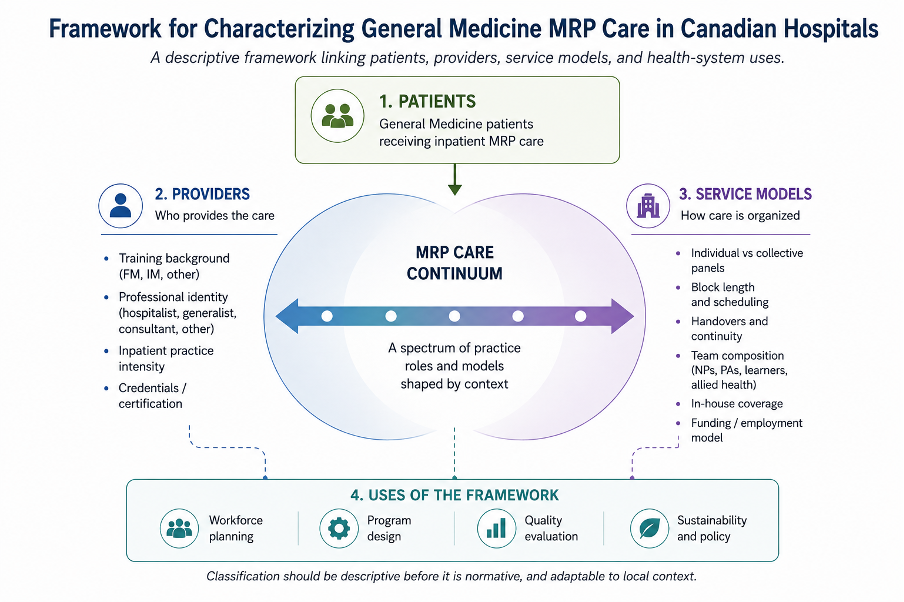
Image created by ChatGPT
Despite these concerns, characterizing the workforce involved in the provision of hospital care can still be useful in a number of ways. It can help identify potential gaps in training or certification, ensuring that the individuals who engage in acute care have the necessary skills to deliver high quality care. It can also help policy makers engage in health human resource planning in a more deliberate and evidence informed manner. Additionally, defining the different MRP service models can also be helpful to organizations as they design and optimize their MRP programs for GM patients. A comprehensive framework for understanding hospital-based general medicine care needs to not only describe the patient population, but also the providers and service models.
The Patients: Growing and Possibly More Complex
GM services represent the single largest inpatient service line in most Canadian acute care hospitals. In the GEMINI cohort of seven teaching hospitals in the Greater Toronto Area a decade ago, general internal medicine accounted for 38.8% of all admissions from the emergency department and 23.7% of all hospital bed-days, with admission volumes rising by 32.4% over a five-year period (Verma et al., 2017). The median patient was 73 years old and carried six coexisting conditions. In many community hospitals — where there is no large subspecialty apparatus to absorb the more clearly categorisable presentations — the proportion of medical beds occupied by GM patients is likely higher.
These patients are also widely described as becoming more complex over time, and the population-level evidence broadly supports that characterisation. Naik and colleagues (2024), examining more than 3.3 million non-elective admissions in British Columbia over a 15-year interval, found that most markers of complexity increased over time.
The Historical Baseline: Geography as Destiny
Historically, the answer to "who is the Most Responsible Physician?" in Canadian hospitals depended almost entirely on where one happened to be standing.
In large academic centres, general internists functioned as de facto hospitalists within Clinical Teaching Units, a model that predates the language of hospital medicine by several decades (Redelmeier 1999). In urban and semi-urban community hospitals, the majority of medical inpatients were admitted under the care of their own family physician, with a subset going directly to medical subspecialists (such as cardiologists). And in rural hospitals, family physicians provided essentially all inpatient care given that in many cases they were the sole available physician workforce (Yousefi & Chong, 2013).
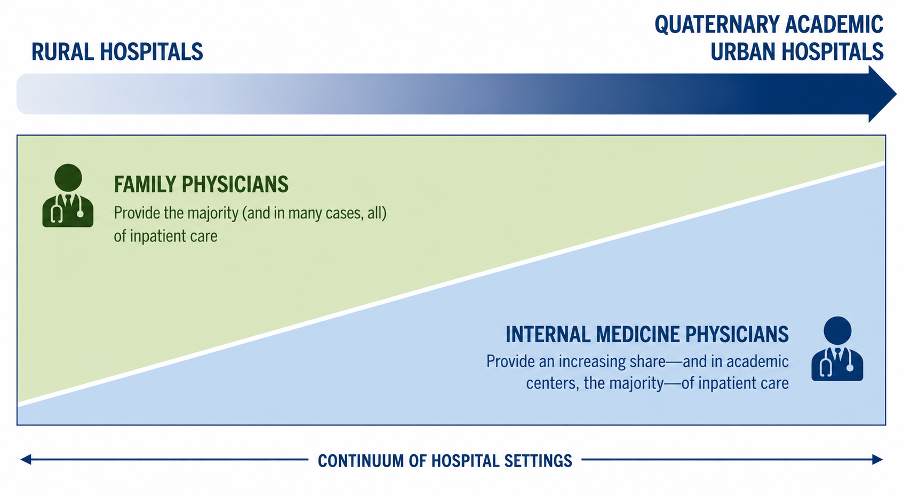
Image created by ChatGPT
This distribution reflected, and to a considerable extent still reflects, the underlying shape of the Canadian physician workforce. Roughly half of all physicians in this country are family physicians; of the specialist half, general internists constitute a relatively small subset: there are fewer than 3500 general internists in active practice across the country, against more than 42 000 family physicians (Yousefi, Coke, & Eisner, 2021). There have never been anywhere near enough general internists to staff Canada's medical wards, and the bulk of GM inpatient care has therefore always fallen, by necessity rather than by design, to family physicians.
Trend One: The Concentration of Inpatient Work into Fewer Hands
The clearest and best-documented trend of the past two decades is that GM inpatient care has become concentrated among a much smaller number of physicians, each of whom does a great deal more of it.
Heather White's analysis of Ontario administrative data remains, to my knowledge, the most methodologically rigorous Canadian attempt to quantify this. Rather than relying on self-identification, she defined hospital-based physicians functionally, using aggregated measures of inpatient service volume. Using that approach, she documented a statistically significant rise, beginning around 2000/01, in the number of high-volume hospital-based family physicians in Ontario, accompanied by corresponding declines in the numbers of high-volume internists and other specialists. By 2010/11 she estimated that there were approximately 620 full-time and 520 part-time hospital-based physicians in the province — some 4.5% of the active physician workforce — and that a core group of 337 hospital-based generalists (207 family physicians and 130 general internists - roughly 1.3% of all the physicians in the province) was delivering roughly 10% of all inpatient evaluation and care coordination for Ontario residents (White et al., 2013; White, 2016).
More recently, a population-level study from Ontario confirmed the growth of FP’s with focused practices in all areas, including hospital care. Between 1993/94 and 2021/22, the proportion of family physicians in focused practice rose from 7.7% to 19.2%, and hospitalist medicine emerged as the second most common focused practice type at 26.5%, behind only emergency medicine at 37.0% (Ansari et al., 2025). Among women in focused practice, hospital medicine was in fact the single most common choice, at 32.2%.
The mirror image of this concentration is the withdrawal of community-based FPs from acute care. A department of family medicine at an urban hospital in Hamilton conducted serial surveys of its members in 1977, 1997, and once more in 2014. The proportion of respondents caring for general medicine inpatients fell from 44.9% in 1977, to 3.0% in 1997, to effectively zero acting as MRP by 2014 (Neimanis et al., 2017). Nationally, the proportion of family physicians and general practitioners listing a community hospital as one of their practice settings fell from 39.3% in 2004 to 23.4% in 2014.
British Columbia offers a useful cross-check on all of this. Writing on behalf of the General Practice Services Committee in 2013, Winsby reported that, over the preceding decade, approximately 3% of family physicians had ceased providing inpatient care each year — cumulatively leaving some 30% fewer family physicians doing hospital work in 2013 than in 2003 (Winsby, 2013). A decade further on, the Family Practice Services Committee put the number of community-based family physicians still providing inpatient care services in the province at roughly 1800 (FPSC, 2023). Set against a provincial family physician workforce several times that size, the figure speaks for itself.
Trend Two: From Individual Practice to Group-Based Coverage
The second trend over the past 2 decades has been a shift towards group practices. The model of individual physicians managing individual panels of inpatients has largely given way to groups — most commonly described as Hospital Medicine (HM) programs — in which physicians hand over patients to one another, cross-cover, and collectively guarantee continuous coverage of a defined patient population.
The first such service in Canada opened at Calgary's Peter Lougheed Hospital in 1998, and by 2012 there were over 100 programs nationally (Yousefi, 2015; Lamber and Jamieson., 2019). That number has continued to grow and the Canada Chapter of the Society of Hospital Medicine now estimates that there are over 240 hospital medicine programs in almost all provinces and territories. What is easy to miss, for anyone who has not looked at these programs recently, is the sheer scale that many of them have reached. At Trillium Health Partners in Mississauga, 55 internal medicine hospitalists work alongside 15 family medicine hospitalists to provide MRP coverage for more than 13 000 acute medical admissions annually, involving up to 400 inpatient beds at any given time. At Fraser Health in British Columbia, around 300 hospitalists (around 200 Full Time Equivalents) are responsible for over 50 000 admissions per year across a network that now spans 21 acute care facilities. And in the Calgary Zone of Alberta Health Services, a program staffed entirely by family medicine-trained hospitalists accounts for roughly 14 700 admissions a year — approximately 61% of all medical admissions in the zone (Yousefi, Coke, & Eisner, 2021; Yousefi, 2025). These are not niche services operating at the margins of the institution. In a growing number of Canadian jurisdictions, they are the general medicine service.
What I find most notable about this trend is that it is no longer a metropolitan phenomenon. Fraser Health implemented new hospitalist services at three of its facilities between 2016 and 2018, one of which was a small community hospital in a semi-rural town (Yousefi & McIvor, 2021), and comparable transitions have taken place in centres such as Sechelt, British Columbia and Camrose, Alberta. The threshold hospital size at which a group-based model becomes a necessity has dropped considerably over the past decade, and I would expect it to continue to do so.
Trend Three: The Compartmentalisation of Clinical Time
Inpatient care has shifted from something done alongside other clinical activity to something done instead of other clinical activity, in discrete blocks of time. One-week and two-week inpatient blocks are now more or less the standard configuration across Canadian HM programs, and during those blocks the physician typically does little or nothing else. The morning round followed by a day in the office has, for this segment of the workforce, essentially disappeared.
This represents a genuine break with the traditional model, and — as with most structural changes in health care — it cuts in both directions. Block scheduling concentrates expertise, permits on-site physician presence throughout the day, makes 24-hour coverage achievable, and creates a sustainable rhythm of work and rest that is almost certainly a precondition for retaining people in this line of work at all. At the same time, it builds discontinuity into the system by design, since every block boundary is a handover; and it transforms inpatient medicine from one dimension of a broad generalist practice into a distinct career pathway, which in turn accelerates precisely the concentration described above. The three trends, in other words, are not independent of one another.
Trend Four: A Widening Definition of "Most Responsible"
Finally, and more tentatively, the MRP role itself is beginning to widen beyond physicians. Nurse Practitioner-as-MRP models have been piloted in Canadian hospitals since at least the mid-2010s (Acorn, 2015), and dedicated hospital and acute care training pathways for NPs now exist at Canadian universities. Physician Assistants have been integrated into inpatient teams in several provinces. These models remain uncommon, and are considerably more often team-embedded roles than true MRP roles. But they indicate that the MRP concept may gradually extend beyond physicians in selected settings. It is worth noting that the terminology itself is quietly shifting, from "Most Responsible Physician" to "Most Responsible Provider."
Why Did This Happen?
None of this was the product of a single policy lever, which is precisely why it has proven so resistant to reversal. When Rafal Maslowski and I reviewed the Canadian literature on this question some years ago, we identified three interacting families of drivers: physician-related factors (workload and time pressure, deliberate choices to limit scope of practice, remuneration, an ageing workforce, work-life balance considerations, and the difficulty of maintaining acute care skills alongside a community practice); system-related factors (reductions in physician supply, resident duty-hour restrictions in teaching hospitals, declining acute bed numbers against rising occupancy, cost containment pressures, and growing administrative complexity); and patient-related factors (the rise of unattached patients, population ageing, and medical complexity) (Yousefi & Maslowski, 2013).
What matters most, though, is the interaction among these factors rather than any one of them in isolation. It is why targeted interventions — a fee code adjustment here, a recruitment incentive there — have not reversed this trend in any jurisdiction that has attempted it, and why I doubt they will.
The Measurement Problem: A Workforce We Cannot Count Easily
The reorganization of hospital-based care and the emergence of new MRP models (such as hospital medicine programs) alongside the more “traditional” service types has changed how hospitalised GM patients receive medical care. But as I alluded to earlier in this article, lack of clarity around definitions has significantly impacted our ability to better understand who is providing MRP service to this patient population.
For example, while we know that an increasingly larger proportion of inpatient care is delivered by “hospitalists”, we cannot readily count hospitalists in Canada. There is no specialty designation for hospital medicine, no national registry, and no billing category that reliably identifies the work. Even if we consider hospital medicine as simply a focused practice area within the broader specialty of family medicine, lack of formal recognition hampers our ability to better identify individuals who dedicate their clinical practice to acute GM care.
This significantly limits the utility of administrative databases in studying GM hospital coverage. CIHI's National Physician Database classifies family physicians practising outside primary care by mapping their billing profiles onto recognised specialty equivalents — emergency medicine at 14.2%, psychiatry at approximately 5%, general surgery at 2.1% (CIHI, 2024). Hospital medicine does not appear anywhere in that taxonomy, for the simple reason that it is not a recognised specialty. The consequence is that one of the largest domains of focused family practice is functionally invisible in our national workforce data.
Nor is it recognised in credentialing. The College of Family Physicians of Canada has established Certificates of Added Competence in emergency medicine, palliative care, care of the elderly, family practice anaesthesia, sport and exercise medicine, addiction medicine, and enhanced and obstetrical surgical skills. There is no CAC in hospital medicine, more than a decade after the need for one was first articulated in the pages of CMAJ (Smith & Sivjee, 2012).
As a result, surveys of self-identified hospitalists remain one of the primary sources of Canadian data on this workforce, which inevitably inherit all of this above described ambiguity, along with the usual selection and sampling biases. For example, since many general internists who work in academic hospitals (as part of the CTUs) do not self-identify as hospitalists, their contribution to the care of GM patients is largely not represented in such surveys. The surveys also under-represent family physicians who may participate in HM programs occasionally, but whose main clinical domain remains longitudinal ambulatory primary care. Even if hospital medicine was a recognized specialty, we still need a way to capture the contribution of these other MRP providers if we are to generate a comprehensive picture of providers involved in general medicine.
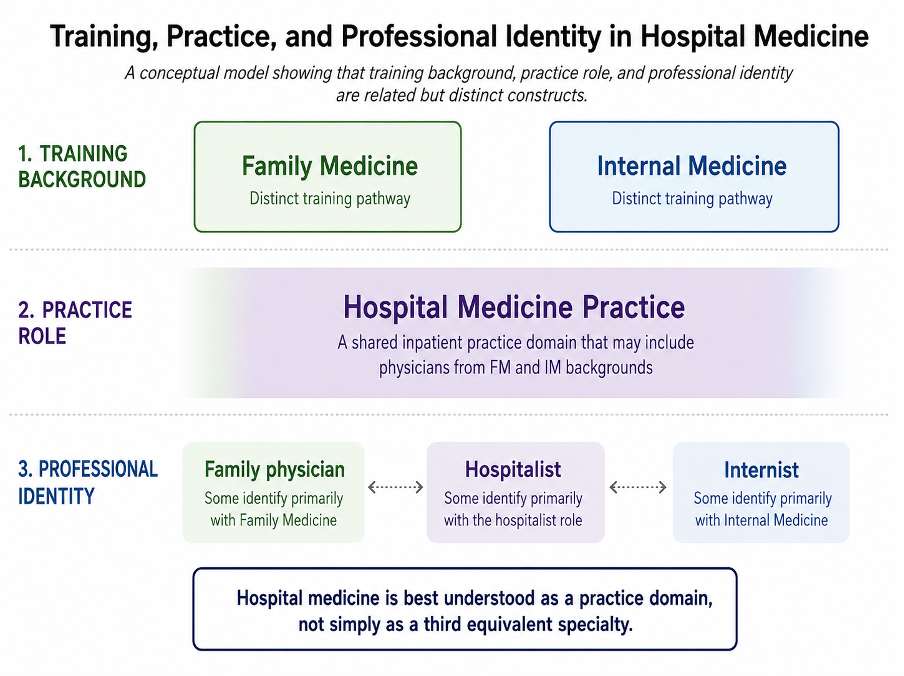
Image created by ChatGPT
Canadian General Medicine coverage must be understood along at least three distinct dimensions: the training background of the provider, the function and intensity of the provider’s hospital practice, and the organizational model through which care is delivered. Conflating these dimensions and a focus on professional identity can make the workforce difficult to identify, count and plan for.
The Second Measurement Problem: Defining Service Lines
While we try to better understand the characteristics of the individual providers who engage in the care of general medicine patients in the hospitals, we also need to increase our understanding of how these providers are organized as part of the program and service lines that cater to this patient group. Two programs sharing the label "hospitalist" may differ enormously in caseload, coverage hours, handover structure and cohorting, while a CTU and a hospital medicine group operating in the same teaching hospital may, on those same dimensions, be very nearly indistinguishable.
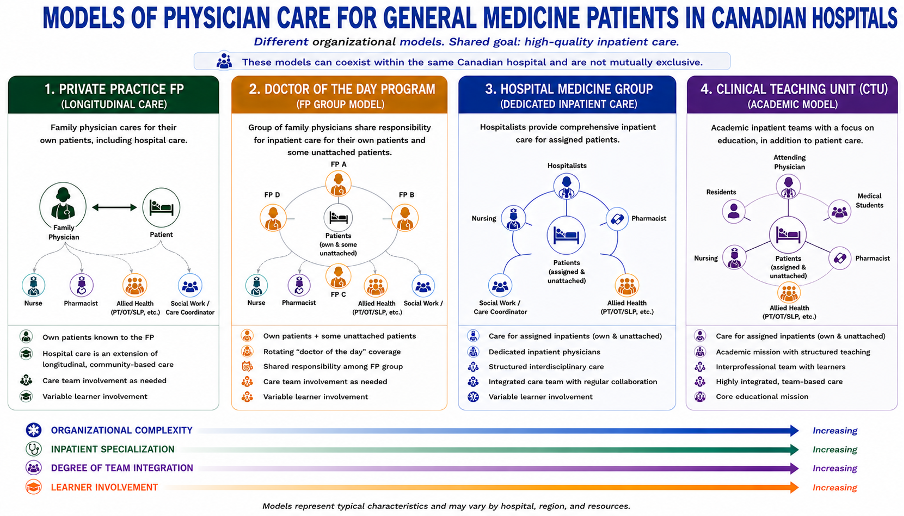
Image created by ChatGPT
The defining attributes are not mysterious, and most will be immediately familiar to anyone who has run such a service: whether physicians hold individual patient panels or care for them collectively; whether handovers are ad hoc or built into the schedule by design; the length of the working block; the size of the caseload; whether patients are geographically cohorted or distributed across the building; the hours during which a physician is physically present in the facility; responsibility for unassigned patients; the extent of formal co-management with other services; the presence of learners and the supervision structure that follows from it; the employment and funding model; and the composition of the wider team, including nurse practitioners and physician assistants. Provider training background remains one attribute among these — but only one, and I increasingly suspect a less predictive one than we have generally assumed.
It is important to keep in mind that such a framework must be descriptive before it is normative. There is an understandable temptation to build the classification out of what we understand to be best practices. The Society of Hospital Medicine's assessment guide, which sets out 47 characteristics under ten principles (Cawley et al., 2014), and my own earlier work with Canadian health system leaders on the characteristics of an ideal program (Yousefi & McIvor, 2021) were each explicitly aspirational in intent. But a classification assembled out of best-practice attributes quietly encodes the urban, well-resourced model as the standard, and thereby consigns the rural hospital that cannot staff continuous in-house coverage to the status of a deficient version of something else, rather than a legitimately different model suited to a different context. Our previous attempts to describe different models for HM program along a maturation continuum may serve as a possible approach. After describing a number of stages of HM program development, along with various descriptive attributes, we were then able to use national survey data to validate the model (Yousefi & Evans 2021). While the validation work uncovered different thresholds for some of the program attributes, the overall taxonomy seemed robust. Such an approach needs to be expanded to include other GM MRP models and include more variables in the validation work.
What Should We Do About This?
If we accept that GM services represent the largest single block of inpatient beds in the country, and that the workforce staffing those beds has been substantially reorganised over two decades, then a number of priorities follow:
Define the workforce functionally rather than by self-identification. White's method of identifying hospital-based physicians through inpatient service volumes remains the most promising approach available to us, and it has been neither replicated nationally nor updated in more than a decade. This is eminently achievable using existing administrative data holdings, and it should be done. Such an analysis should also include other available data (beyond billing volumes) for further refinement.
Characterise the service models in addition to the providers who staff them. Along with our need to better understand the providers involved in GM care, we also need to concurrently better characterise the service models within which they operate. This would shift the unit of analysis from the individual provider to the program, and allow for an expanded assessment of the various models of inpatient care that exists across the vast continuum of acute care hospitals in the country. A program taxonomy such as those previously proposed can be a starting point.
Resolve the recognition gap. Whatever one's position on whether hospital medicine ought to be a distinct discipline in Canada — and reasonable people disagree — the current situation, in which tens of thousands of admissions annually are managed by a workforce that our credentialing and workforce planning systems do not formally acknowledge, serves nobody well. Formal recognition can range from recognizing HM as a stand-alone speciality, or simply an area of added competence/focused practice. There is ample precedent in Canada (eg. the evolution of Palliative Medicine), but the political will among national credentialing bodies has been sorely lacking.
Treat inpatient and primary care workforce planning as inter-related challenges. Movement of family physicians into or out of hospital medicine can materially affect community primary-care capacity, although the effect depends on their prior and concurrent scopes of practice and is bidirectional. Following implementation of the LFP model, several BC hospital medicine programs reported substantial recruitment and retention pressures as physicians reconsidered the relative attractiveness of community and hospital practice. There is a significant need for generalist physicians to care for patients in both the acute and community settings, as the patient need in all these areas continues to expand. As long as the pool of providers does not grow proportionally to increasing demands, introducing financial incentives for any type of practice only results in practice pattern changes that only shift the HHR crisis, not solve it.
Take the sustainability of the existing workforce seriously. A survey of British Columbia hospitalists conducted in early 2022 found high rates of burnout, with workload a key associated factor, and a substantial proportion of respondents contemplating reducing or ending their involvement in acute care altogether (Yousefi, 2025). Roughly 40% of that workforce was under 40 and within five years of entering practice — a cohort whose retention will largely determine our inpatient capacity for the next two decades.
Conclusions
Canadian hospitals have, over roughly twenty years, quietly restructured the way they provide care to their largest inpatient population. The physicians involved are broadly the same two groups as before — family physicians and general internists — but they are far fewer in number, they are doing far more of the work, they are organised into groups rather than practising individually, and they are doing that work in concentrated blocks of time rather than as one thread within a broad generalist practice. This restructuring has been driven by an interlocking set of physician, system and patient factors, and it is, in my view, irreversible.
None of that is necessarily a bad thing. There is reasonable evidence that dedicated inpatient care models perform at least as well as the arrangements they replaced, often with sicker and more complex patients (Yousefi et al., 2020). But we are now in the position of depending on a workforce that we cannot enumerate, whose scope we have not defined, whose training we have not standardised, and whose sustainability we have not measured except in isolated provincial surveys.
The question of who provides MRP care to general medicine inpatients in Canada, and within which model of coverage, is not an academic one. It is a health human resources question of the first order — and the fact that we currently cannot answer it with any precision should trouble us rather more than it appears to.
References
● Acorn, M. (2015). Nurse practitioners as most responsible provider: Impact on care for seniors admitted to an Ontario hospital. International Journal of Nursing and Clinical Practice, 2, 126.
● Ansari, H., Glazier, R.H., Schultz, S.E., Green, M.E., Premji, K., Frymire, E., Daneshvarfard, M., Jaakkimainen, L., & Kiran, T. (2025). Family physicians in focused practice in Ontario, Canada: A population-level study of trends from 1993/1994 through 2021/2022. Annals of Family Medicine, 23(3), 181–190.
● Canadian Institute for Health Information. (2024). Changes in practice patterns of family physicians in Canada. Ottawa, ON: CIHI.
● Cawley, P., Deitelzweig, S., Flores, L., Nelson, J., Seymann, G., Sylvia, B., & Whitcomb, W. (2014). The key principles and characteristics of an effective hospital medicine group: An assessment guide for hospitals and hospitalists. Journal of Hospital Medicine, 9(2), 123–128. https://doi.org/10.1002/jhm.2119
● Family Practice Services Committee. (2023, June 27). Update on FPSC stabilization funding for inpatient, long-term & maternity care. Vancouver, BC: FPSC. https://fpscbc.ca/news/news/update-fpsc-stabilization-funding-inpatient-long-term-maternity-care
● Naik, H., Murray, T.M., Khan, M., Daly-Grafstein, D., Liu, G., Kassen, B.O., Onrot, J., Sutherland, J.M., & Staples, J.A. (2024). Population-based trends in complexity of hospital inpatients. JAMA Internal Medicine, 184(2), 183–192.
● Neimanis, I., Woods, A., Zizzo, A., Dickson, R., Levy, R., Goebel, C., Corsini, J., Burns, S., & Gaebel, K. (2017). Role of family physicians in an urban hospital: Tracking changes between 1977, 1997, and 2014. Canadian Family Physician, 63(3), 221–227.
● Redelmeier, D.A. (1999). A Canadian perspective on the American hospitalist movement. Archives of Internal Medicine, 159(15), 1665–1668. https://doi.org/10.1001/archinte.159.15.1665
● Lambert, L., & Jamieson, P. (2019). Preserving generalist skills in the NHS - is a medical hospitalist service the way forward? The Canadian experience and how it could translate to the NHS. Future healthcare journal, 6(Suppl 1), 63. https://doi.org/10.7861/futurehosp.6-1-s63
● Smith, S.D., & Sivjee, K. (2012). Defining training needs, core competencies and future certification for Canadian hospitalists. CMAJ, 184(14), 1557–1558.
● Ghahtarani, A., Roberts, S. B., Wodchis, W. P., Razak, F., Verma, A. A., & Sarhangian, V. (2026). Trends in general internal medicine patient and care complexity from 2017 to 2022 across 21 hospitals. (2026). Journal of General Internal Medicine. doi:10.1007/s11606-026-10586-1
● Verma, A.A., Guo, Y., Kwan, J.L., Lapointe-Shaw, L., Rawal, S., Tang, T., Weinerman, A., Cram, P., Dhalla, I.A., Hwang, S.W., Laupacis, A., Mamdani, M.M., Shadowitz, S., Upshur, R., Reid, R.J., & Razak, F. (2017). Patient characteristics, resource use and outcomes associated with general internal medicine hospital care: The General Medicine Inpatient Initiative (GEMINI) retrospective cohort study. CMAJ Open, 5(4), E842–E849.
● White, H.L. (2016). Assessing the prevalence, penetration and performance of hospital physicians in Ontario: Implications for the quality and efficiency of inpatient care [PhD thesis]. Toronto, ON: Institute of Health Policy, Management and Evaluation, University of Toronto.
● White, H.L., Stukel, T.A., Wodchis, W.P., & Glazier, R.H. (2013). Defining hospitalist physicians using clinical practice data: A systems-level pilot study of Ontario physicians. Open Medicine, 7(3), e74–e84.
● Winsby, B. (2013). In-patient Care program supports physicians and continuous care in BC. BC Medical Journal, 55(7), 325.
● Yousefi, V. (2015, October). What's in a name — defining hospitalists in Canada. Healthy Debate.
● Yousefi, V. (2025). Prevalence of burnout and impact of workload on physician wellness: A cross-sectional survey of hospitalists in British Columbia, Canada. Journal of Hospital Medicine, 20(7), 688–700.
● Yousefi, V., Coke, W., & Eisner, J. (2021). Training and certification for hospital medicine programs support the essential role of hospitalists for complex multi-morbid patients in acute care. Canadian Journal of Physician Leadership, 7(3), 125–131. https://doi.org/10.37964/cr24738
● Yousefi, V., & Chong, C.A.K.Y. (2013). Does implementation of a hospitalist program in a Canadian community hospital improve measures of quality of care and utilization? An observational comparative analysis of hospitalists vs. traditional care providers. BMC Health Services Research, 13, 204.
● Yousefi, V., & Evans, M. (2021). Variation amongst hospital medicine programs in Canada: Development and validation of a classification scheme and diagnostic tool. Vancouver, BC: Hospitalist Consulting Solutions. www.hospitalistconsulting.com
● Yousefi, V., Hejazi, S., & Lam, A. (2020). Impact of hospitalists on care outcomes in a large integrated health system in British Columbia. Journal of Clinical Outcomes Management, 27(2), 59–72.
● Yousefi, V., & Maslowski, R. (2013). Health system drivers of hospital medicine in Canada: Systematic review. Canadian Family Physician, 59(7), 762–767.
● Yousefi, V., & McIvor, E. (2021). Characteristics of the ideal hospitalist inpatient care program: Perceptions of Canadian health system leaders. BMC Health Services Research, 21, 685.